
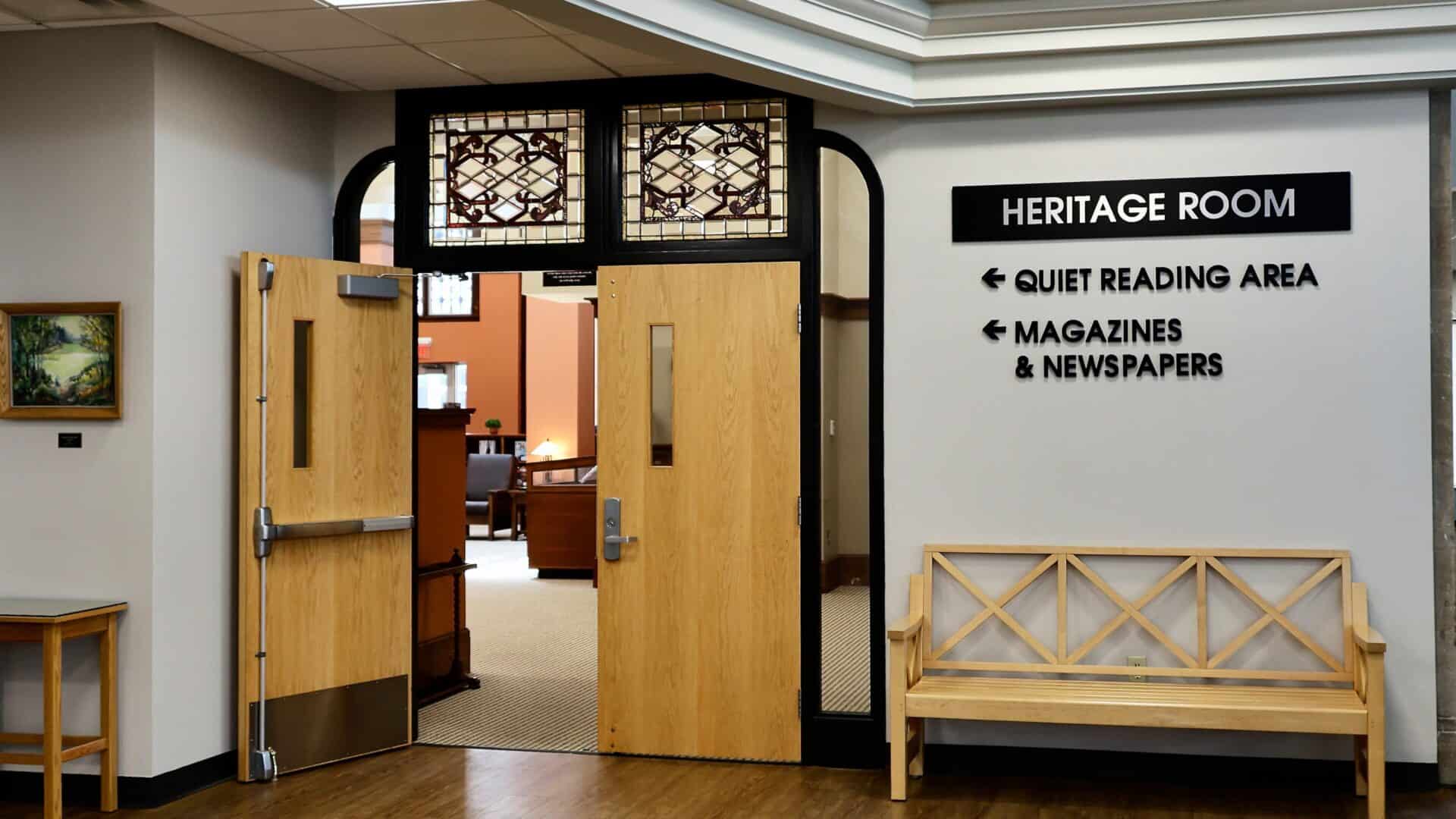
A History of the Heritage Room
1914
1970
1974
1995
1998
2020
2021
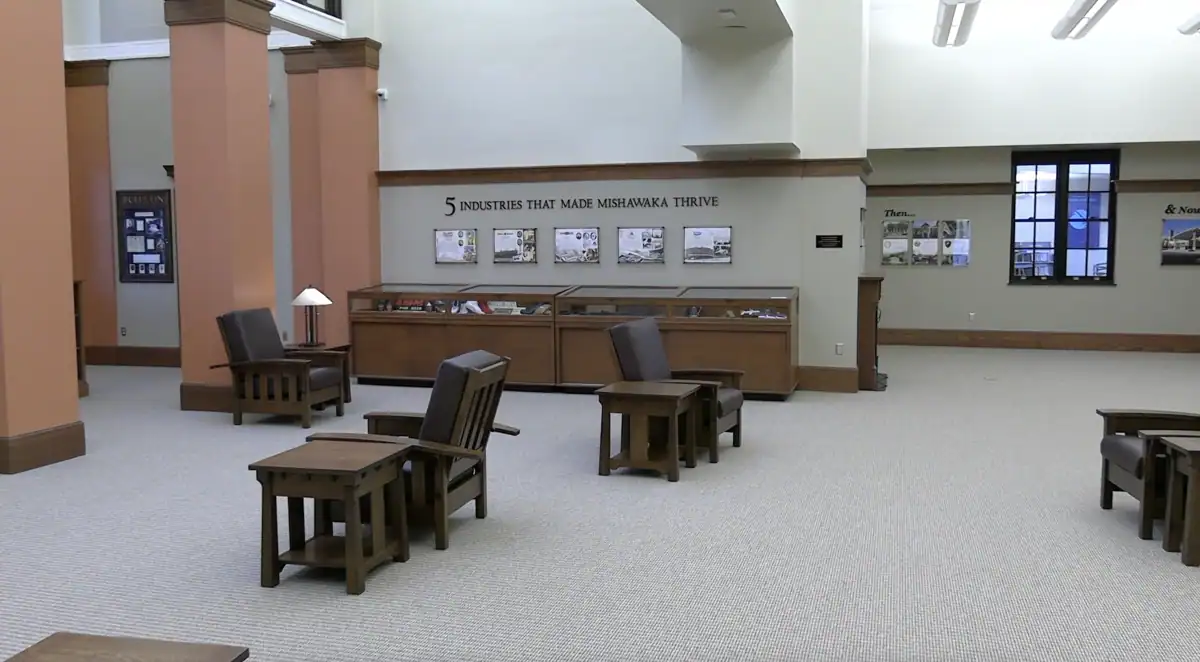
Today’s Heritage Room
The building exterior has retained the early 1900s architecture, original exterior doors and the magnificent interior woodwork. Near the original exterior doors facing Church Street, a photograph from 1917 of Army recruits gathering outside the U.S. Post Office is proudly displayed.
When you enter the room, look up. A portion of the postman’s catwalk, complete with cutouts to carefully watch postal employees sort the mail, still remains. Comfortable Amish-made furniture, natural lighting and LED lighting allow for a comfortable, quiet reading experience.
Hand-crafted enclosed exhibit cases contain artifacts that highlight five Mishawaka industries that have helped shape the Princess City. Many of the artifacts in the Heritage Room are on loan from Mishawaka historian Peter De Kever. MPHPL thanks De Kever for his assistance with the loan of items along with the help of historical fact-finding for the Heritage Room displays.
Additional exhibits highlight some of Mishawaka’s most notable names with a spotlight on the Jernegan and Powell families.
Indiana Passport Program
- MPHPL is one of over 150 libraries that are part of the Indiana Library Passport program due to the unique/historical significance of our MPHPL Heritage Room and Shiojiri Room.
Exhibit-Related Documentaries
Use arrow keys to navigate between accordion items, and use enter to open them.
Heritage Room History Overview
Video Transcript: Pete De Kever – Mishawaka Heritage Center
Video Transcript: Pete De Kever – Mishawaka Heritage Center
| Audio | Visual |
|---|---|
| [Pete De Kever] I am Pete De Kever. I am the Historian Laureate for the city of Mishawaka. | Pete De Kever walks along the sidewalk of South Main Street, moving out of frame of the camera. |
| [De Kever] I am also president and curator of the Mishawaka Historical Museum that will be opening next year on South Main Street – in downtown Mishawaka. | De Kever speaks while sitting. A sign hangs in the window that reads “Mishawaka Historical Museum.” |
| [De Kever] This building was originally built as the U.S. post office for Mishawaka … constructed around 1914. | The historic U.S. Post Office building in Mishawaka is now part of the Mishawaka-Penn-Harris Public Library. |
| [De Kever] During World War I the recruiting officer used this building to sign up recruits to go off to war. | Historic photo from May 10, 1917 shows World War I recruits outside the U.S. Post Office in Mishawaka. |
| [De Kever] It served as the post office until 1969, when we opened the new post office across the intersection of Church and Third. | Traffic flows past the historic U.S. Post Office building, now part of the Mishawaka Library. |
| [De Kever] By about 1974, the Mishawaka Police Department moved in here. | South Bend Tribune photos show the building exterior and a jail cell under construction (Feb 17, 1974). |
| [De Kever] The police department was here until 1995 when they opened their new building and the public library was looking to expand. | Photo shows the interior of the police department with people working at desks; traffic flows past the building. |
| [De Kever] Create an even larger presence here on this block to serve the needs of the community. | Traffic at Lincolnway East and Church Street intersection with the southwest corner of the Mishawaka Library visible. |
| [De Kever] Since about 1998, this space has been called the Heritage Center. | De Kever speaks while sitting. |
| [De Kever] Brought together all the library’s resources — microfilm, books, files on Mishawaka history, genealogy … | Traffic flows past the building; microfilm scanner, books and file cabinets are shown. |
| [De Kever] It served that purpose until the pandemic when the space and library were closed for a while … | Photos of the Heritage Room show stained-glass windows, display case, clock, bookshelves and seating. |
| [De Kever] Heritage Center resources were brought down to the reference department so they remained accessible. | Library employee assists a person near a copier; sign on the wall reads “Local and Family History.” |
| [De Kever] They realized this could become a reading room — something the library did not have. | Wooden doors open to a fireplace and inviting space. |
| [De Kever] As part of plans for the reading room they wanted to display artifacts and photos on the history of this building and of Mishawaka. | Plaques and display boards titled “Then…” mounted on the wall with historic photos and a gold text plaque honoring founders and architects. |
| [De Kever] The space will be a reading room but along the walls and in display cases will be items reflecting Mishawaka’s history. | Wooden chairs and tables, display cabinet, wall-mounted lamps create a calm ambience. |
| [De Kever] “Five Industries That Made Mishawaka” is the title for the exhibit. | Display of “5 Industries That Made Mishawaka Thrive” with five framed panels and a wooden display case beneath. |
| [De Kever] Initially those industries will be the largest and most prominent historic industries in Mishawaka — Ball Band, Dodge, Wheelabrator, Bendix and Kamm & Schellinger Brewery. | Display panels for Ball Band, Dodge, Wheelabrator, Bendix and Kamm & Schellinger Brewery. |
| [De Kever] We may rotate some industries in the future but these five are a good start. | De Kever speaks while sitting. |
| [De Kever] Certainly Ball Band, Dodge, and Wheelabrator were the largest employers in Mishawaka. | Collage of historical images of factories and advertisements. |
| [De Kever] Bendix was also a major employer and Kamm & Schellinger may not have been as large but everyone identifies with beer (Laughs). | Photos of an aircraft factory and brewery workers posing with barrels and signs. |
| [De Kever] Their buildings remain from the Kamm & Schellinger Brewery as part of the 100 Center. | Photo of the Kamm & Schellinger Brewery showing industrial buildings and smokestack. |
| [De Kever] We have artifacts from all five industries — physical artifacts and photographs. | De Kever speaks while sitting. |
| [De Kever] Shoes made at Ball Band, beer bottles from Kamm, products from Wheelabrator and Dodge. | Display cases show shoes, beer bottles and industrial parts from each company. |
| [De Kever] We also have models of Talos missiles manufactured by Bendix for the U.S. Navy in the 1950s–1990s. | Display case with ship model “USS Long Beach” and two missile replicas. |
| [De Kever] It’s important we continue telling the story of industries that built Mishawaka and made it what it is today. | De Kever speaks while sitting. |
| [De Kever] Many people don’t remember Ball Band — it’s been 21 years since the factory was demolished — younger residents never saw it. | Photo of brick building by the river labeled “Mishawaka Rubber & Woolen Manufacturing Co.” |
| [De Kever] There’s a need to remember we used to make Talos missiles here — the most advanced product ever built in Mishawaka. | Technical drawing of a missile and photo of technicians working at the Bendix Missile Test Lab. |
| [De Kever] Or the wide range of products Ball Band made — footwear, Ensolite foam, Naugahyde®, adhesives, fuel tanks … | Collage of factory photos and aerial views of Ball Band facilities. |
| [De Kever] Many don’t realize what Wheelabrator made — enormous industrial equipment. | Aerial photo of Wheelabrator headquarters and interior factory equipment. |
| [De Kever] The library will continue the industrial exhibit and profile other factories in the future — we’ll need artifacts to tell those stories. | De Kever examines the “5 Industries That Made Mishawaka Thrive” display in the library. |
| [De Kever] We are always accepting donations of artifacts and photographs from community members. | De Kever speaks while sitting. |
| [De Kever] They want to share these with a larger audience — our industrial heritage is not just the past … we can still make things here. | Historic items from the “5 Industries That Made Mishawaka Thrive” display. |
| [De Kever] Maybe future inventors and entrepreneurs in our schools will start businesses that change the world — maybe this exhibit or museum inspires them. | De Kever speaks while sitting; Heritage Room shown with stained-glass windows and display cases. |
| [De Kever] People should be proud of the history-related exhibits here and of this beautifully restored building. | De Kever speaks while sitting. |
| [De Kever] It will last forever if the community continues to value it. | Traffic flows past the historic U.S. Post Office building in Mishawaka, now part of the library. |
MPHPL Veterans Day Tribute
Video Transcript: MPHPL Veterans Day Tribute
Video Transcript: MPHPL Veterans Day Tribute
| Audio | Visual |
|---|---|
| [Pete De Kever] The photograph itself is just a wonderful patriotic image that shows Mishawaka recruits heading off to serve in World War I on May 10, 1917. | A large group of men dressed in early 20th-century attire gather on the steps of the U.S. Post Office in Mishawaka, holding signs that read “Enlist Now” and “Join the U.S. Army.” |
| [De Kever] The building they are standing in front of is the U.S. Post Office. | Pete De Kever speaks while seated. Lower-third reads: “Pete De Kever – City of Mishawaka Historian Laureate.” |
| [De Kever] which today is part of the Mishawaka-Penn-Harris Public Library. It is where the Heritage Room is. | The U.S. Post Office’s neoclassical building features tall columns and large windows, set against a blue sky with scattered clouds and a waving U.S. flag. |
| [De Kever] And once they got enough recruits, | Library interior with “Restrooms” and “Heritage Room” signage. A wooden bench and table create a calm atmosphere. |
| [De Kever] they decided, well, we’ll make an event out of it. We’ll have the men gather on the front steps of the post office and do a parade through town. | Pete De Kever speaks. A black metal fence surrounds the steps of the U.S. Post Office. |
| [De Kever] The line of march was north on Church Street. They crossed Lincolnway and went down to First Street, down the hill. | Fast-motion video from a vehicle showing the route traveled by recruits and parade attendees. |
| [De Kever] Then west on First to Main, south on Main back to Lincolnway, west on Lincolnway one block to Mill Street, and then south on Mill to the railroad depot. | Fast-motion video continues, tracing the described route. |
| [De Kever] At that time, Mill went all the way through to the railroad tracks. Today, it hits the hospital and doesn’t go through. | Fast-motion video stops at the hospital where the street now ends. |
| [De Kever] There were perhaps several thousand people in the area around the post office. People were invited to join the parade. | Historic photo shows a large crowd near early 20th-century cars, wearing hats and suits near train tracks. |
| [De Kever] One account said the crowd at the depot was even larger than the one in front of the post office. | Historic photo of the Mishawaka train station with a gabled roof and railway tracks. |
| [De Kever] The final farewell to those soldiers occurred at the passenger depot — perhaps three to five thousand people swarming around that train. (Steam locomotive whistles) | Pete De Kever speaks while seated. Photo of a crowd at the train station in early 20th-century attire. |
| [De Kever] It would have been a really exciting moment in Mishawaka history. | Train on the tracks as people wave from the caboose; a woman in a dress waves back. |
| [De Kever] There are compelling stories represented in that photograph. | Pete De Kever speaks while seated. |
| [De Kever] Those men didn’t know what lay ahead. They knew they were going off to France — but we know what happened. Five of those men died during their military service. | Large group photo of recruits on the steps of the U.S. Post Office holding patriotic signs. |
| [De Kever] One man died of disease — Paul Oppelt, a guard in Hoboken, New Jersey, who developed double pneumonia and died there. | Headshot of Paul Oppelt in military uniform, followed by footage of his headstone in St. Joseph Catholic Cemetery, Mishawaka, with a U.S. flag nearby. |
| [De Kever] Four men died in combat or from wounds. | Pete De Kever speaks while seated. |
| [De Kever] Part of that group of 76 was Ben Fetters, a prisoner of war who survived by hiding beneath fallen soldiers. He lived a long life and died in 1975. | Headshot of Ben Fetters in uniform, followed by his bronze grave marker inscribed “Ben A. Fetters 1894–1975.” |
| [De Kever] He and his wife are buried in Southlawn Cemetery. | Exterior view of Southlawn Cemetery under overcast skies with autumn trees and a sign reading “Southlawn Cemetery.” |
| [De Kever] Floyd Godfrey’s remains were brought home after the war. | Headshot of Floyd E. Godfrey in military uniform, his name in white text on sepia background. |
| [De Kever] Joseph Van de Putte’s remains were never recovered. | Headshot of Joseph Van de Putte in uniform, his name displayed in bold white text. |
| [De Kever] His name appears on a memorial in France for missing soldiers. | Pete De Kever speaks while seated. |
| [De Kever] Firmin Van Holsbeck is buried at an American military cemetery east of Paris. | Headshot of Firmin C. Van Holsbeck in uniform followed by an image of white marble crosses at a military cemetery. |
| [De Kever] Don Bryan is buried in Plymouth. | Headshot of Donald C. Bryan in uniform on sepia background. |
| [De Kever] This image, when you look closely, has patriotic signs and flags — it’s worth far more than a thousand words. | Pete De Kever speaks while seated. Photo of WWI recruits on the post office steps. |
| [De Kever] We encourage patrons to come into the library and visit the Heritage Room. | Heritage Room interior with tall windows, wooden tables, and cozy seating. |
| [De Kever] From there, you can look west and essentially stand behind the men in the photograph. | Pete De Kever speaks while seated. |
| [De Kever] You can stand behind the windows, seeing what they saw. Though much has changed, it helps you feel connected to those men — to stand in their place. | The framed 1917 photograph of WWI recruits displayed beside large windows overlooking the same steps. |
| [De Kever] To look at that photograph, see those faces staring back at you across more than a century — that’s how we make history personal and real. | Pete De Kever speaks while seated, followed by a slow zoom into the 1917 photograph. |
| [De Kever] By encountering that photograph, we connect with our past. | The Mishawaka-Penn-Harris Public Library logo with the tagline “Learning for a Lifetime” and URL “mphpl.org.” |
A Jernegan Family Tribute
Video Transcript: MPHPL Jernegan Family Tribute
MPHPL Jernegan Family Tribute Transcript
| Audio | Visual |
|---|---|
| [Richard Jernegan Doolittle] The Jernegan family has a special history in Mishawaka and it’s nice that it’s preserved. | Richard Jernegan Doolittle, a Jernegan family descendant, sits in an office and speaks. Lower-third reads: “Richard Jernegan Doolittle, Jernegan Family Descendant.” |
| [Narrator] The story of how well the Jernegan family history is preserved at the downtown Mishawaka Library is evident before even entering the Heritage Room. | Doorway to the Mishawaka Library Heritage Room. Stained-glass windows above the entrance. |
| [Narrator] The stained-glass windows with intricate colored glass design mounted high above the doors were once mounted in the Jernegan family home. | Plaque reads: “Stained Glass – These windows were removed from the third-floor addition to the Jernegan home. The metal frame around the glass was custom built in Canada specifically to house this glass.” |
| [Jernegan Doolittle] The library parking lot actually is located where Edward Jernegan’s home was. | Street signs at Race Street and Third Street outside the Mishawaka Library and parking lot. |
| [Jernegan Doolittle] My name is Richard Jernegan Doolittle. I am one of the founders of Cressy Commercial Company in Mishawaka. | Jernegan Doolittle speaks in his office. |
| [Jernegan Doolittle] My great-grandfather was Edward Jernegan, proprietor of the Mishawaka Enterprise for a number of years. | Sepia-toned family-tree chart showing Edward A. Jernegan and Nannie Campbell (great-grandparents), Ralph H. Jernegan and Estella May Frank (grandparents), Paul Frank and Imogene L. Jernegan (uncle and aunt) with portraits. |
| [Jernegan Doolittle] He was the postmaster here as well as proprietor and publisher of the Mishawaka Enterprise through the early 1920s. | Photo of the Mishawaka Post Office (1894) with workers surrounded by piles of mail on tables and shelves, on a sepia background. |
| [Jernegan Doolittle] When he passed away and my grandfather Ralph assumed ownership … | Headshot of Edward Allen Jernegan (1846–1922) on sepia background with name label. |
| [Jernegan Doolittle] … which ultimately became my uncle Paul’s office and apartment building; directly to the south was my grandfather Ralph and Estella’s home – both houses were integral to the modernization of the Mishawaka Public Library. | Genealogy chart repeated with portraits of family members; photos of the two Jernegan homes (street and aerial views) on sepia background. |
| [Jernegan Doolittle] At the time of gifting those properties to the library, it immediately became a feature of the library – and it’s nice that it’s continued. | Jernegan Doolittle speaks; historical display cabinet in the Mishawaka Library Heritage Room shown. |
| [Jernegan Doolittle] I never really knew Edward Jernegan, only stories about him that I learned through my family. | Inside the display cabinet is a family portrait of the E.A. Jernegan family. |
| [Drew Hartwell Johnson] Edward would have been my great-great-grandfather, whom I never met. | Drew Hartwell Johnson sits in an office and speaks. Lower-third: “Drew Hartwell Johnson, Jernegan Family Descendant.” |
| [Drew Hartwell Johnson] I am in the IT support business, very much not the family norm. We keep businesses up and running and out of harm’s way. | Hartwell Johnson works on a computer; exterior of his business IP Solutions. |
| [Drew Hartwell Johnson] My middle name is Hartwell … passed down from my grandfather Ralph Hartwell Jernegan as a way to honor family lineage. | Genealogy chart on sepia background showing Drew’s ancestors with headshots and labels. |
| [Jernegan Doolittle] Drew – he doesn’t like to admit it – but he’s my nephew. | Jernegan Doolittle speaks. |
| [Drew Hartwell Johnson] My uncle Rick also shares a middle name – Jernegan. | Drawing of the Jernegan family crest on a desk beside family photos. |
| [Jernegan Doolittle] My uncle’s middle name is important to him as it was his mother’s maiden name. | Jernegan Doolittle speaks. |
| [Jernegan Doolittle] Edward was my great-grandfather and his son Ralph was my grandfather – an attorney and Indiana legislator. | Family portrait of E.A. Jernegan family on sepia background. |
| [Jernegan Doolittle] He and his wife Estella had three children. | Photo of Ralph and Estella Jernegan inside the Heritage Room display cabinet. |
| [Jernegan Doolittle] He was a lawyer in Mishawaka and decided to sell the Mishawaka Enterprise to focus on his practice. | Newspaper titled “The Mishawaka Enterprise” and antique glasses inside display cabinet. |
| [Jernegan Doolittle] My grandfather was an Eagle Scout and very active in the Scouting movement. | Hartwell Johnson sits before a display of family portraits. |
| [Jernegan Doolittle] He helped create the Mishawaka Res camp area and donated money to build the Jernegan Lodge there. | Boy Scouts certificate for Ralph H. Jernegan; views of Mishawaka Res sign, lodge and dedication plaque. |
| [Jernegan Doolittle] Paul Frank Jernegan was an architect – very creative and successful. He designed the additions to Mishawaka High School so seamlessly you can’t tell old from new. | Hartwell Johnson speaks; photos of Paul Frank Jernegan (1908–1993) and Mishawaka High School clock tower and entrance. |
| [Drew Hartwell Johnson] My Uncle Paul had offices in Goshen and Chicago and was friends with Frank Lloyd Wright, whom he admired greatly. | Map drawn by Paul Frank Jernegan of Midwest states and photo of Paul with Frank Lloyd Wright. |
| [Jernegan Doolittle] Uncle Paul envisioned bringing Chicago-style retail and offices to downtown Mishawaka – a vision that later came true in many ways. | Jernegan Doolittle speaks; map of Paul’s Central Business District proposal and modern street views through Mishawaka. |
| [Jernegan Doolittle] Major companies like Liberty Mutual and retailers such as Penney’s, Sears and Macy’s opened in Mishawaka – realizing parts of his vision though without the proposed tower. | Driving footage through Main Street and Grape Road intersections; illustration of the 1967 proposed Mishawaka tower on sepia paper. |
| [Drew Hartwell Johnson] My memory of Paul is that of an eccentric architect who loved Mishawaka deeply. He lived humbly and treated our family as his own. | Headshot of Paul Frank Jernegan (1908–1993) and family photos on a shelf of the Jernegan home. |
| [Drew Hartwell Johnson] Over time I was entrusted with family heirlooms – furniture, desks and a car – including a custom desk my uncle designed with Italian marble top and mystery buttons. | Antique cabinet and car; close-ups of the desk’s wood and marble details and buttons. |
| [Drew Hartwell Johnson] He was like me – a pack rat of family history – and we owe him gratitude for saving so much of our heritage. | Hartwell Johnson speaks. |
| [Narrator] He even designed hand-drawn Christmas cards each year. | Illustrated Christmas card by Paul Frank Jernegan. |
| [Drew Hartwell Johnson] This one was for his studio – “Studios of Paul Frank Jernegan.” It’s epic; I keep it out year-round because I love it. | Illustration shows Santa Claus carrying a bag of buildings over Indiana, Michigan, Illinois and Wisconsin. |
| [Narrator] A copy of the card is in the Jernegan bookcase below the silhouetted sign that once stood outside Paul’s architectural office. | Mishawaka Library Heritage Room display case with the card and historic sign. |
| [Jernegan Doolittle] Everything important to the betterment of the community was a principle obligation of the Jernegan family. | Jernegan Doolittle speaks. |
| [Drew Hartwell Johnson] Being a descendant of that family is an honor. I’m very proud and loyal to Mishawaka – and many families here share that same sentiment. | Family portrait of the E.A. Jernegan family on sepia background; Hartwell Johnson speaks; Mishawaka-Penn-Harris Public Library logo and URL “mphpl.org.” |
A Powell Family Tribute
Video Transcript: MPHPL Powell Family Tribute
MPHPL Powell Family Tribute Transcript
| Audio | Visual |
|---|---|
| [John Charles Bryant] Most people call me John Charles. I’m 84. | John Charles Bryant sits in a chair and speaks. Two maps behind him show Saint Joseph County and Mishawaka, Indiana. |
| [Bryant] My last name is Bryant, b-r-y-a-n-t. | Bryant speaks. |
| [Bryant] Our family built the first Black church in South Bend – Olivet AME (African Methodist Episcopal). | |
| [Narrator] The church still bears the same name but is now in a different location and building. | Sign for Olivet African Methodist Episcopal Church and street-view of the exterior. |
| [Narrator] The original cornerstone is located out front along with a historical marker. | Cornerstone engraved “Olivet A.M.E. Church – Organized 1870 – Built 1871 – Rebuilt 1916” and Civil Rights Heritage Center marker. |
| [Bryant] It’s at 719 Notre Dame Avenue. The old church was at 310 West Monroe. | Street-view of the church’s exterior. |
| [Bryant] My mother was the church organist for 40 years. | Bryant speaks. |
| [Bryant] My mother passed away when I was 12 – her name was Georgia Ward Bryant. | Headshot of Georgia Ward Bryant (1891–1951) on sepia background with name label. |
| [Narrator] Georgia was descended from the Powell family, one of the first Black families to settle in the Michiana area. | Genealogy chart showing John’s ancestry with photos and dates on sepia background. |
| [Bryant] The Powells were very industrious people – wholesome, honest and dependable. Their word was their bond, and they were proud of their accomplishments. | Portraits of Farrow Powell and Rebecca M. Bass; Squire Powell and Levicy Kendall; George Ward and Minnie Powell; John Casper Bryant and Georgia Mae Ward. |
| [Bryant] We are a very proud family. Farrow Powell had 17 children. | Bryant speaks. |
| [Peter De Kever] Farrow Powell was one of the most significant African Americans in St Joseph County – a wealthy landowner at the center of the Black community for decades. | Headshot of Farrow Powell (1809–1887) on sepia background; De Kever stands at City Cemetery in South Bend. |
| [De Kever] Numerous members of the Powell family are buried here in City Cemetery. | Gravestone reads “Farow Powell Died Aug 16 1887”. |
| [Bryant] Peter De Kever has done a lot of research on the Powells – maybe more than some family members themselves. | Bryant speaks; lower-third reads “John Charles Bryant, Powell Family Descendant.” |
| [De Kever] The Powell story in Mishawaka begins when Elijah Powell arrived with his wife and daughter around 1868 – a Civil War veteran of a colored infantry regiment. | De Kever speaks in Mishawaka Library Heritage Room; plaque reads “The Elijah Powell Family: Mishawaka’s African American Pioneers.” |
| [De Kever] Elijah ties into the history of colored troops fighting for the Union during the Civil War. | Headshot of Elijah Powell (1841–1906) on sepia background; photo of Civil War soldiers holding muskets. |
| [Bryant] Medora Powell was way ahead of her time – the first Black graduate of Mishawaka High School, class of 1887. | Headshot of Medora Powell (1866–1931) and portraits of Mishawaka High School and its 1887 class photo. |
| [De Kever] We have her 1887 commencement program on display in the Powell Family case inside the Heritage Room. | Framed commencement program inside Heritage Room display cabinet. |
| [Bryant] Medora taught school in Cassopolis and was well thought of in the community. | Bryant speaks. |
| [De Kever] This is Fairview Cemetery in Mishawaka where several of Elijah and Maryanne Powell’s children are buried – including Medora. | Street view and gravestone reading “Medora Powell 1866–1931”. |
| [Bryant] This is the house on Cedar Street – the Powell family home still standing at 109 South Cedar in Mishawaka. | Bryant points to framed photo; street view of Powell Family house. |
| [De Kever & Narrator] Elijah was a barber in Mishawaka from 1868 to 1906 and had 14 children with Maryanne Powell. | Gravestone reads “Elijah H. Powell 1841–1908 / Maryann 1843–1902 Powell.” |
| [De Kever] Raymond Powell, another son, was the second Black graduate of Mishawaka High School (1908) and became a Chicago dentist after studying at Fisk and Northwestern. | Framed photo of Raymond Powell; drawing of Fisk University Jubilee Hall on sepia background. |
| [De Kever] Otto Powell was a barber for over 60 years – he knew everyone in Mishawaka and represents the beginnings of the Black community here. | Gravestone “Otto C. Powell 1881–1956 Father”; headshot of Otto on sepia background; barbershop photo on aged paper. |
| [Bryant] We’ve got 87 descendants – maybe more now – and when I put out a plea for funds to buy wreaths, everyone comes together to decorate graves across Mishawaka and South Bend. | Bryant speaks; family portraits and Powell graves with wreaths and decorations. |
| [Bryant] This year we used whirlybirds – they move in the wind next to our family graves as a symbol of life and memory. | Decorative bee and flower pinwheel spins by gravestone with flag and flowers. |
| [Narrator] One still remains next to his parents’ gravesite where he placed it in summer 2021. | Gravestone reads “Bryant – Georgia Ward 1891–1951 / John O. 1886–1961”. |
| [Bryant] That’s my way of feeling close to family. | Bryant speaks; breeze moves the pinwheel and flag at Bryant family gravesite. |
| [Narrator] John Charles died less than a month after this interview on January 3, 2022. | Gravestone reads “Son John Charles Bryant 1937–2022 Loved Life.” |
| [Peter De Kever] John was the family historian – he did so much to promote Black history in South Bend and Mishawaka and was the last Powell descendant living here. | Portrait of Bryant displayed at his funeral with flowers; De Kever speaks. |
| [De Kever] He worked with local museums and helped donate Elijah Powell’s military papers to the library – away from the family for decades before his efforts brought them home. | Certificates from Elijah Powell’s military service (“Bureau of Pensions” and “The Commanding Officer of the Regiment”) displayed in Heritage Room case. |
| [De Kever] His loss is deeply felt in the community – we are grateful for his lifelong promotion of our shared history as Mishawaka becomes more diverse. | Headshot of John Charles Bryant (1937–2022) on sepia background; Mishawaka-Penn-Harris Public Library logo and URL “mphpl.org.” |